


Words have always mattered to me.
I can’t remember a time when I didn’t have some kind of journal nearby. Remember those little diaries that came with a tiny key? Yep, I had one. It’s funny that we thought those locks would keep anyone out.
I’m sitting at my desk in my home office as I write this. From here I can see two half-started journals, one budget journal, two sketchpads, one full journal I recently dusted off for a reread, and four packages of colored pens and markers.
Apparently I collect blank pages almost as much as I collect words.
I was never the person who filled one journal a year and lined them up on a shelf by color and date.
Nope.
Mine are everywhere. Every bag. Every nightstand drawer. Every stack on my bookshelf. Some are completely full. Most are only partially written. Some have a handful of entries before life interrupted and I reached for a different notebook instead.
I’ve gone back and read some of them.
Some make me laugh.
Some absolutely break my heart.
When I was younger they were mostly desperate prayers to God. Page after page of questions, fear, hope, and pleading. Now they read more like love letters to myself. Reflections. Processing. A place where I can tell myself the truth before I can tell anyone else.

In 2018, my mom went in for what was supposed to be a routine physical.
Instead, doctors found a seven-pound tumor, about the size of a football, attached to her ovary.
As any oldest daughter would do, I panicked and sprang into action.
Within hours I had researched ovarian cancer and mentally prepared myself for what I was certain was coming. Her appointments moved quickly and were held in the oncology department. Of course we thought cancer.
I learned the statistics. I learned the awareness color was teal.
I had already built the GoFundMe in my head before anyone actually knew what our journey would be.
Then I did something that feels both completely ridiculous and completely understandable looking back.
I bought three journals.
All teal.
One for my mom. One for my sister. One for me.
I knew we were going to need them. I knew we would have to find somewhere to write. Process. Grieve. I knew we would need to move our feelings out of our bodies and onto paper.
At the time it wasn’t a thoughtful decision.
It was instinct.
Thankfully, the tumor was benign. Several very scary days, one major surgery, and she was well.
I’ve kept those journals. I think of them often — of my gut reaction to go out and buy something meaningful to hold words we hadn’t written yet.
Have you ever found healing through writing?
Writing has always been movement for me.
It’s how I process experiences that feel too big to carry inside my own body. Somehow, putting words on paper makes them lighter. Not because the circumstances change, but because I do.
Last year, when Carter ran from our home and our lives immediately shifted into crisis, I picked up my journal on purpose.
The entries weren’t beautiful.
They were raw. Short. Devastating. Haunting.
Some days I could only manage a few sentences. Other days I wrote until my hand hurt.
Eventually those pages became essays here. The stories didn’t become less painful. They became something I could hold instead of something that held me.
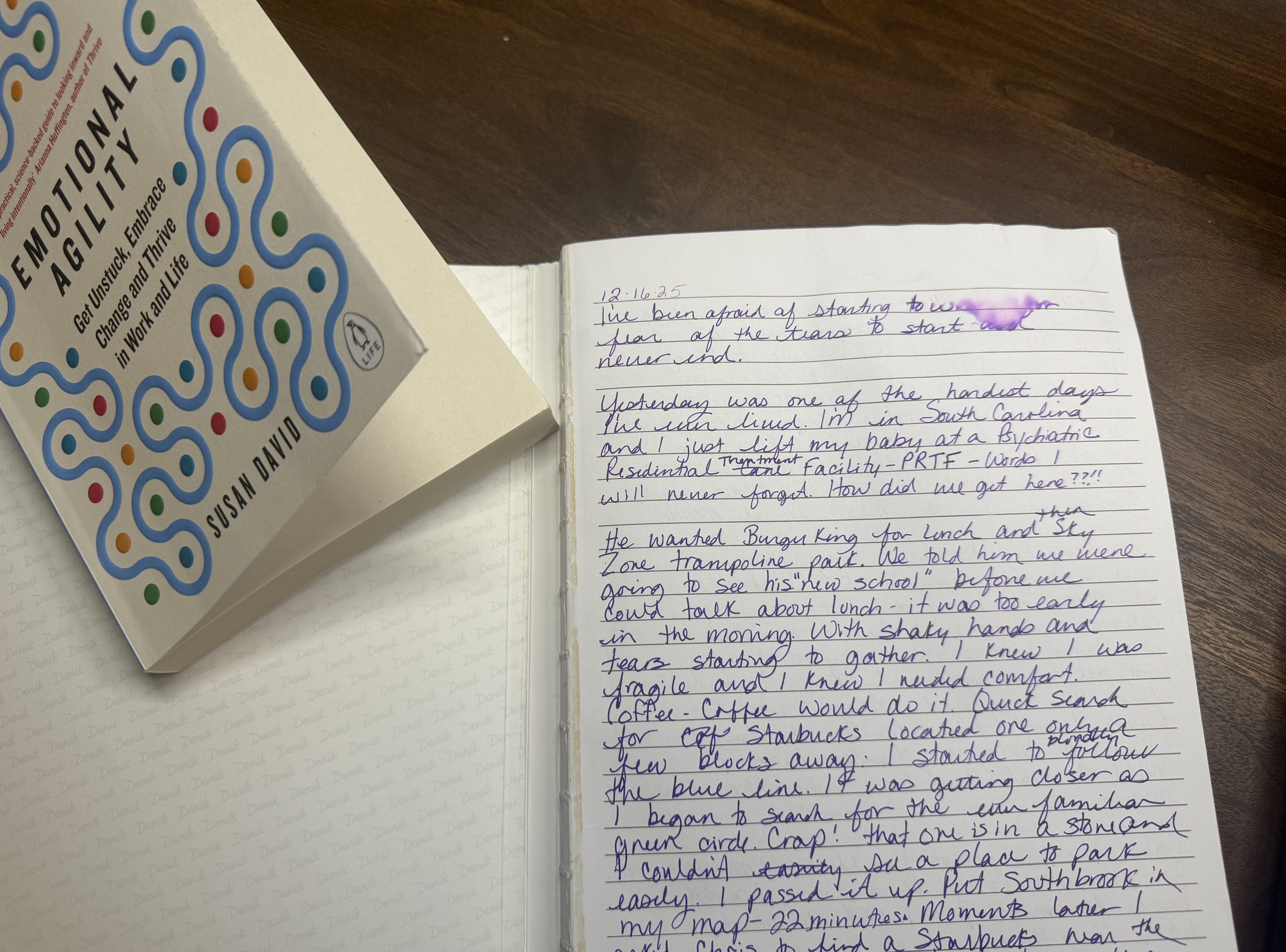
Recently I’ve been reading Emotional Agility by Susan David, and somewhere in the middle of it, one particular section caught my interest.
David writes about the research of psychologist James Pennebaker, whose work has shaped the way many of us think about expressive writing. Across study after study, he found that people who wrote about emotionally charged experiences got measurably better. Not just happier and less anxious. Healthier in ways you can put a number on. Lower blood pressure. Stronger immune function. Fewer visits to the doctor. Better relationships. Better work.
They wrote about the hard thing, and their bodies changed.
The practice itself is almost insultingly simple. Twenty minutes on a timer. A notebook, or a blank document. Write about whatever you have been carrying — this past week, this past month, this past year. Don’t fix the punctuation. Don’t worry about whether it holds together. Go where your mind goes, without judgment, and write it for yourself rather than for anyone who might read it later.
Then do whatever you want with the pages. Keep them. Throw them out. Close the document without saving. Start a blog, if you’re ready. Pennebaker says it doesn’t matter, and he’s right, because the pages were never the point.
…those thoughts are now out of you and on the page.
— Susan David, Emotional Agility
When I read that, I smiled.
Not because I was surprised.
Because someone had finally put research behind something my brain and my body has known for decades.

My writing moves through three stages, and they are not interchangeable.
First I live it.
The joy, the grief, the uncertainty, the fear. The hospital hallway. The phone call. The two metal doors. Life happens long before I write a word about it.
Then I write it.
Not for anyone. For me. This is where the journal comes in. This is where the tears come, where the handwriting goes sideways, where the sentences run on and the thoughts never finish. This is where I find out what I actually think. Most of these pages stay in the journal forever.
Only then do I craft it.
That’s the stage you see. It’s where I move paragraphs around, cut the repetition, hunt for the thread connecting one experience to another, and decide whether something belongs only to me or whether it might help someone else feel a little less alone.
Three stages. In that order. Every time.

And yes — AI is part of the third one.
I don’t ask it what happened. I don’t ask it how I feel. I don’t ask it what I think. Those things are settled long before I open anything.
I bring the messy journal pages. I bring the stories. I bring the lived experience. I bring the draft.
Then I ask for help shaping it.
Sometimes it catches a grammar mistake. Sometimes it tightens a paragraph that had gone slack. Sometimes it notices a connection I was making without realizing I was making it. Sometimes it asks a question that sends me back into the story to dig.
It’s less like hiring a ghostwriter and more like sitting across the table from an editor who asks thoughtful questions.
The thoughts are still mine. The memories are still mine. The conclusions are still mine. The voice is still mine.
Technology doesn’t create my story. It helps me say it clearly.

Here is the part I have had to watch in myself, and it isn’t the part people usually argue about.
The risk was never authorship.
The risk is stage two.
Because I could skip it. I could go straight from the living to the crafting — hand over the raw material, get back something clean and publishable, and never sit in the middle where it costs something. The essay would still be true. It would probably even be good.
And I would have gotten none of the healing.
Pennebaker’s research doesn’t say that well-written accounts of hard experiences lower your blood pressure. It says the writing does. The sitting there. The twenty minutes. The bad handwriting and the crossed-out lines and the sentence you didn’t know you were going to write until it was already on the page.
That part can’t be handed to anyone. Not because it would be cheating.
Because it’s the whole point.
The craft is for you.
The writing was always for me.

Words have always mattered to me.
Not because they make me a writer. Because they’ve helped me become who I am. Writing was never about producing perfect sentences. It was about paying attention to my own life.
Tonight, after this one is finished and formatted and scheduled, I’ll open the paper one.
The journal on my desk is currently filled with thoughts and experiences from my career. My highs and my lows. My values and my goals. Next to it is a page of notes for themes in the book I’m editing — messy, in four different colors.
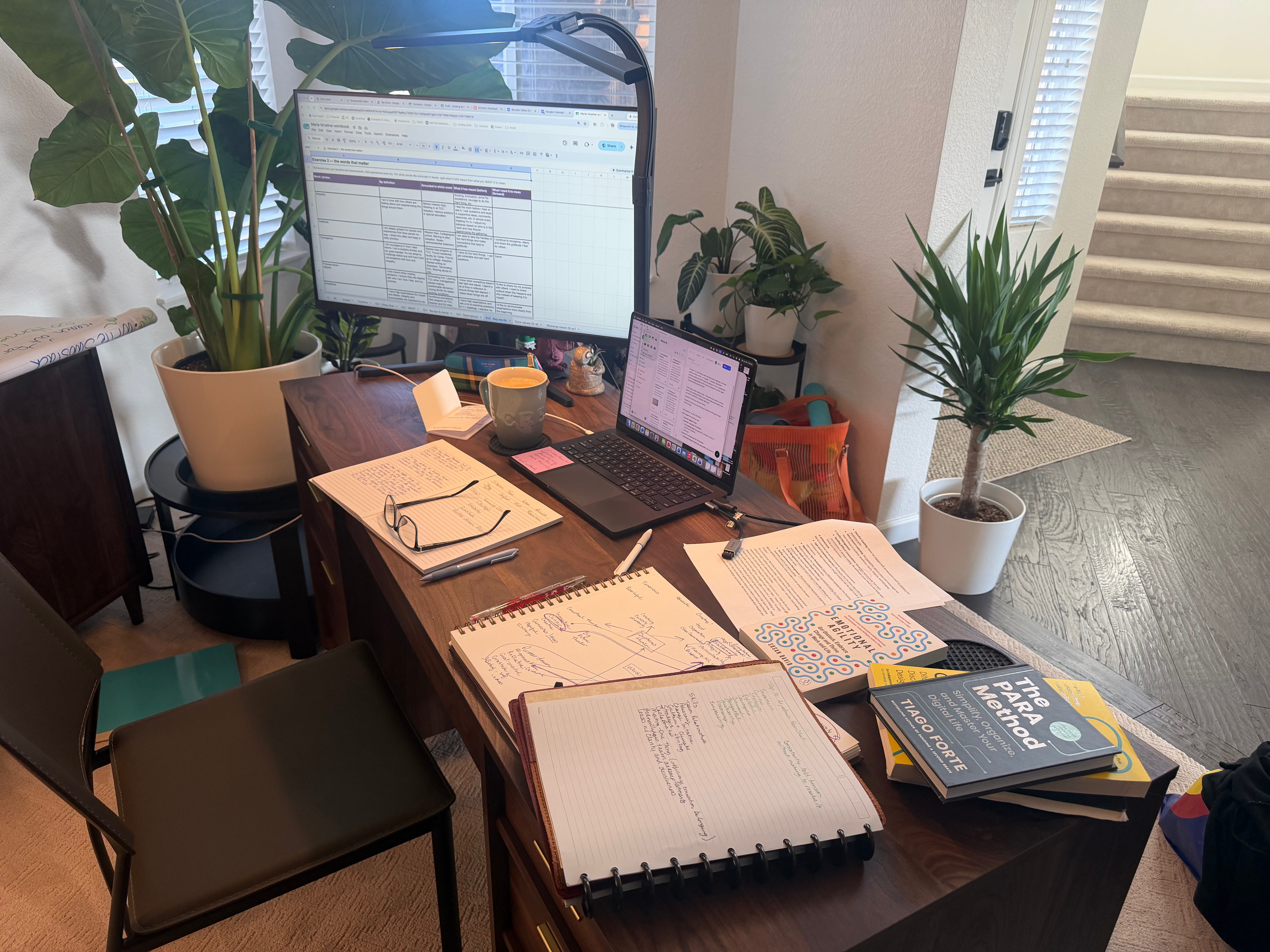
Anyone walking into my office and looking at that mess would wonder whether I have a process.
I do.
I’ve just laid it out for you.
No timer. No reader.
Twenty minutes, or five, or until my hand hurts.
Nobody will ever read it.
That’s where the next one starts.
— Maria
If you set a timer for twenty minutes tonight, what would come out?