

Step 4, up close — Build Relationships Between Meetings
I’m Maria Messer, Special Education Director, writer, and former special education teacher who has sat on nearly every side of the IEP table, including as the mom of a son with significant disabilities. More about me and this space →
This is Step 3 of a framework I’m building out one step at a time — each essay carrying its own tool you can bring to the table, each one building on the last. It picks up from Step 3, Focus on the Student, Not the Position, and starts with the introduction, Families Deserve a Map. If you’re new here, start there.
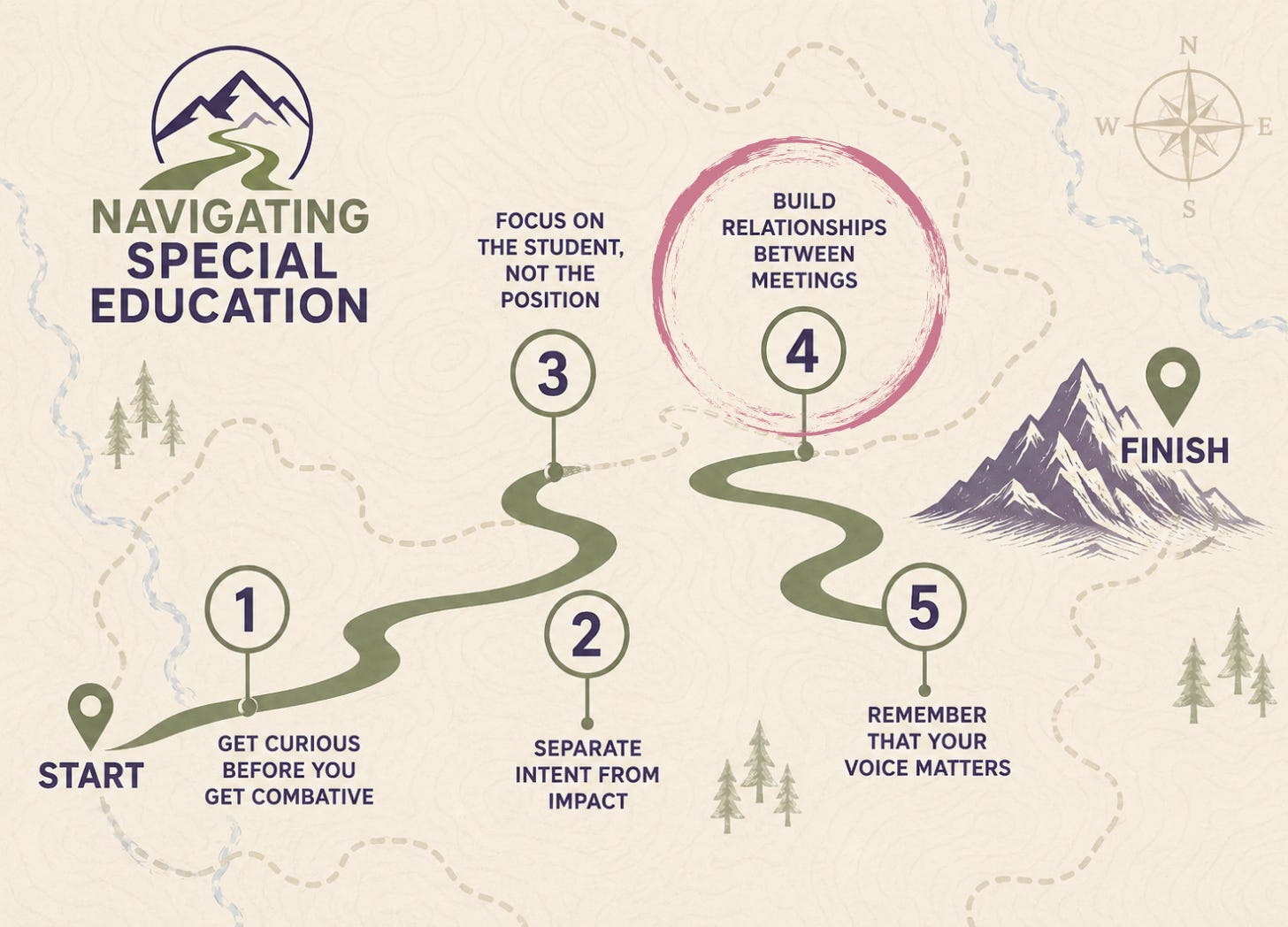
The first three steps all live inside the meeting. Get curious in the room. Name the impact in the room. Bring it back to the child in the room.
Step 4 is the one that happens everywhere else.
Here’s something I’ve watched from both chairs, and it took me years to see it clearly. The parents who get heard in the hard meetings are almost never the ones who show up only for the hard meetings. They’re the ones the team already knows by October. The ones who sent the thank-you in September. The ones whose name, when it lands in an inbox, doesn’t make a teacher’s stomach tighten before she’s even opened the message.
That isn’t favoritism. It’s how trust works. And the thing nobody tells you is that the most important conversation you have all year is often not the annual meeting at all. It’s the small, ordinary contact you make in the eight months before it, when nothing is wrong and there’s nothing to win.
Trust isn’t built in the meeting. It’s built in the small moments between them.
You can’t manufacture trust in the ninety minutes you’re all seated around a table with a decision to make. That room is too emotional, too high-stakes. Trust gets built in the smaller touchpoints throughout the year.
The rest of this essay comes with the tool I built for it, a set of message templates for staying connected across the year without it taking over your life. You can download it a little further down.
Families deserve a map.
Two things the research keeps apart
There’s a distinction from the research that’s worth looking at, because it explains why the meeting itself is the wrong place to build what you need.
Amy Edmondson, the Harvard researcher whose work on teams we met back in Step 1, draws a careful line between two things people usually blur together. One is psychological safety, the shared sense that a room is safe enough to speak up in, to ask the naive question, to admit you don’t understand. The other is trust, which she describes as something narrower and more personal: your expectation that a specific person will act in your interest. And here’s the part that matters for us. She finds that trust between two people is built the slow way, through repeated positive interactions over time. Not declared. Accumulated.
Read that again with an IEP meeting in mind. You are walking into a room and hoping to build, in ninety tense minutes, a thing the research says is made of many small moments spread across months. No wonder it feels impossible. You’re trying to grow in one sitting something that only grows in installments.
I’ve sat in meetings where parents and educators had known each other for years. The conversation wasn’t easy, but it was possible because there was already history between them. I’ve also sat in meetings where everyone was meeting for the first time around a disagreement. Those are much harder places to begin.
Step 4 is about making the installments.
If this is landing, there’s a whole map like it. Five steps, each with a tool you can bring to the table. It’s free, and new pieces arrive as I build them out.
What actually builds it
The good news hiding in that research is how ordinary the building blocks are. Honestly, this surprised me. I used to think trust was built during the meeting itself. Trust doesn’t come from grand gestures. It comes from small, positive, repeated contact, and small is the operative word. You are not trying to befriend the team. You’re trying to become a known, warm, easy-to-work-with presence in your child’s school life, so that when a hard conversation does come, it happens between people who already have some good history to stand on.
Four kinds of small contact do most of the work. None of them takes more than a few minutes.
The thank-you. The most underused message in special education. When someone does something well, say so, specifically. Not “thanks for everything,” but “the visual schedule you set up is the first thing that’s helped them with transitions.” Specific thanks tells a teacher you’re paying attention to what’s working, not just stockpiling what isn’t. It also does something quieter: it makes you a person whose messages are safe to open.
The small share from home. A one-line window into your child that they can’t see from school. “They came home talking about the science experiment for twenty minutes, first time all year.” These are gifts. They hand the team a piece of your child they don’t otherwise get, and they signal that you see school and home as one, not two separate worlds.
The early flag. When something small is starting to feel off, name it while it’s still small, in a low-key note rather than saving it for the table. “They’ve seemed more anxious about drop-off this week, wanted to flag it in case you’re seeing anything too.” An early flag is a gift of trust, not a complaint. It says: I’d rather solve this with you now than surprise you with it later.
The check-in. A short, no-agenda touch at a calm moment. “How are they settling into the new group?” It keeps the line warm when there’s nothing wrong, which is exactly the time that makes the line usable when something is.
Do a handful of these across a year and you change what you are to that team. You stop being a name that appears only when there’s a problem and become a partner they hear from all along.
Why the timing is the whole point
Here’s the piece people miss. The value of these messages is almost entirely in when you send them.
A warm note in October costs you two minutes and buys you something you cannot purchase in March. Edmondson’s research is blunt on the fragility here: trust that takes months to build can be damaged by a single bad interaction. Which cuts both ways for us. It means the hard meeting is genuinely dangerous to a relationship, so you don’t want it to be the first substantial contact you’ve ever had. And it means the good history you build in the easy months is what carries the relationship through the hard one.
Think of it as making deposits. Every specific thank-you, every small share, every early flag is a small deposit into an account you may need to draw on later. The parent who’s made twenty deposits by spring can afford to make a withdrawal, can disagree hard in a meeting, and the relationship holds, because there’s a balance there. The parent who’s made none is asking for trust on credit, in the exact moment it’s hardest to extend.
You are not being calculating by doing this. You’re being early.
The tool for this one
Knowing you should stay in touch and actually doing it, in the middle of a working life and a family, are two different things. That gap is what the tool is for.
The Between-Meetings Scripts, your download. A set of short message templates, one for each kind of contact, plus a simple rhythm for the year so you’re never staring at a blank message wondering what to say.
It gives you three things.
The templates. Fill-in-the-blank versions of the thank-you, the small share, the early flag, and the check-in. Each is two or three sentences. Don’t send a book, send a note. The template makes sure it lands warm and clear.
A light rhythm for the year. Not a calendar that runs your life. A gentle suggestion of when each kind of message fits, so “stay in touch” turns into something you can actually picture doing without dreading it.
A one-line rule for the early flag. The hardest of the four to get right, because it’s the one where a question can read as a complaint. There’s a simple structure that keeps it landing as partnership: what you noticed, that you’re flagging it early, and an open question that invites their view.
Fill none of it in if you don’t want to. Even reading through it will change what you reach for the next time something small happens and you think, I should probably say something.
The part I won’t pretend about
Between-meeting contact doesn’t turn a strained relationship warm on its own, and it isn’t always answered in kind.
Some teams are stretched so thin that your thank-you disappears into an inbox and no one replies. That doesn’t mean it failed. The signal still landed, even if nobody answered. And yes, that can be frustrating. Some relationships are genuinely broken, and no amount of warm notes repairs what needs a harder conversation, or outside help. Building relationships between meetings is not a way to be quiet, or to earn services by being likable enough. Nobody should have to be charming to get their child what the law already entitles them to.
But most relationships aren’t broken. Most are just thin, built on nothing but a once-a-year meeting and a stack of paperwork. And thin is fixable, cheaply, in the months when nothing is on fire.
Where this leaves you
You’ve spent three steps learning how to handle the hard conversation well. Step 4 is the quiet realization that the hard conversation is shaped, long before it starts, by everything that came before it. The relationship you’ll wish you had in March is the one you build in October, in two-minute pieces, when there’s nothing at stake and nothing to prove.
None of this is complicated, we just forget the small things when life gets busy. Send the thank-you. Flag the small thing early. Keep the line warm when it’s easy, so it holds when it’s hard.
That’s Step 4, the fourth leg of the map. One step left, and it’s the one underneath all the others: your own standing in that room, and why it was never in question.
If you ever want to read further (none of it required), this essay leans most on Amy Edmondson’s work on trust and psychological safety in teams (The Fearless Organization), especially her distinction between the two and her finding that interpersonal trust is built through repeated positive contact over time.
— Maria

Before you go — I’d love to hear from you.
This series lives in the special education world because that’s the table I know best, from both sides of it. But the idea underneath Step 4 isn’t about IEPs. It’s true of almost any relationship you’ll one day need and can’t build in the moment you need it: a child’s care team, a doctor’s office, an aging parent’s providers, a new manager, a coworker you only ever email when something’s gone wrong.
So I’ll ask it broadly: when has a relationship you tended in the quiet times carried you through a hard one? Or when did you wish you’d made the small contact before you needed the big one?
Tell me in the comments. I read every one, and your stories shape what I build next.
If you find this resource helpful, please like and/or leave a comment.
Where we are on the map. You just finished Step 4. Here’s the whole thing, and where we’re headed next.
Step 1: Get Curious Before You Get Combative
When something doesn’t make sense, lead with a question instead of an accusation.
Step 2: Separate Intent from Impact
You can believe everyone wants what’s best for your child and still name a problem.
Step 3: Focus on the Student, Not the Position
When you disagree, bring the conversation back to your child’s needs rather than who’s right.
Step 4: Build Relationships Between Meetings (you are here)
Trust is built in the small moments between meetings, not during the annual one.
Step 5: Remember That Your Voice Matters (next)
You are the expert on your child, and you belong at that table.
Such a good reminder that small moments build strong relationships. Thanks for sharing.