


Step 1, up close — Get Curious Before You Get Combative.
I’m Maria Messer, Special Education Director, writer, and former special education teacher who has sat on nearly every side of the IEP table, including as the mom of a son with significant disabilities. More about me and this space →
This is Step 1 of a framework I’m building out one step at a time — each essay carrying its own tool you can bring to the table, each one building on the last. It starts with the introduction, Families Deserve a Map. If you’re new here, start there.
A few weeks ago I wrote about a meeting. A family braced for a fight. A school braced for one. A child in the middle who only needed the adults to work together. I left that room with a knot in my stomach, because I understood everyone in it.
I want to go back to that room. This time I want to slow it down — to the few seconds before anyone braced.
The bracing didn’t start with the documentation, or the advocate, or the careful sentences. It started earlier than that. It started with a feeling. The parent felt something rise, fear mostly, wearing the costume of anger, and reached for the first words that came. The team felt those words land, and reached back. By the time anyone actually spoke, the meeting was already decided.
That moment, the one before the first word, is where Step 1 lives.
The move you reach for first
When something doesn’t make sense in a meeting, the words that come first are almost always the wrong ones. Why aren’t you doing this. This isn’t working. You’re not listening to me. They’re honest. They’re earned. And they close the door.
The curious version of each of those is sitting right there, a half-step behind. Can you help me understand how this decision was made. What is the data showing us. Can I share what I’m seeing at home. Same concern. Same spine. A completely different room.
I know what the curious version can feel like when you’re the parent. It can feel like backing down. Like letting them off the hook. Like being polite while your child goes without.
I want to be clear here.
Getting curious is not the same as backing down.
A question is not a concession.
Curiosity is not surrender.
It’s closer to the opposite. The combative move feels strong. It carries all the heat of fighting for your kid. But it usually costs you the one thing you walked in to get. The curious move feels softer and does more.
And this is the part I most want you to hear: it isn’t a personality trait, and it isn’t me asking you to be the bigger person. It’s a strategy. And it happens to be one of the most studied moves in all of conflict resolution. Below, I’ll show you why it works, who spent their careers proving it, and exactly how to prepare it before your next meeting.
I’m building this framework out the way I’d have wanted it built for me, one step at a time. Each step gets its own essay and its own tool you can carry into the room. And all of it is working toward something larger: a complete Holding Both toolkit for the full five steps, so a family can navigate special education.
Families deserve a map.
The rest of this essay, including the Curiosity Worksheet and Curiosity Scripts you can download right inside it, is for paid subscribers. If that’s you, keep reading. The tool is waiting a little further down.
What a question actually does
Here’s the mechanism. That’s the part that matters.
An accusation hands the person across the table a job: defend yourself. A question gives them a different one: explain, think, solve this with me. You can watch it happen. Accuse, and shoulders rise, sentences get careful, the documentation comes out. Ask, and someone leans in. Not always. But often.
A question also tells the team who you are. It says: I’m here to understand, not to corner anyone. That one signal changes how people treat you, sometimes before you’ve said anything else. There’s no trick to it. You’re being clear about your own intent, and that clarity gives the team room to show you theirs.
And a question buys you something you cannot get any other way: information. The combative move ends the conversation. The curious move opens it, and what comes out is how the decision actually got made. Which is exactly what you need if you’re going to change it.
None of this is new, and none of it is mine. In 1961, a researcher named Jack Gibb sat in on group after group and noticed that some ways of talking reliably put people on the defensive: judging, controlling, sounding certain. Others opened people up: describing what you see, staying open to the answer. Why aren’t you doing this is a judgment. Help me understand how this was decided is a description. Walk into a meeting curious, and you’re applying his finding almost sentence by sentence.
Decades of research since have landed in the same place. Amy Edmondson’s work on psychological safety, the study of why some teams learn and solve hard problems while others freeze, keeps finding that people share more and think more clearly when they feel invited to explain rather than forced to defend. Chris Voss, who spent years negotiating hostage situations for the FBI, built an entire method on the same insight: the calm, curious question is also the one that gathers the most information and lowers the most walls. Even the Harvard team behind Difficult Conversations boils their whole craft down to a single move — trade certainty for curiosity.
You don’t need any of those names to use this. But it helps to know they’re standing behind you. The next time someone implies that staying curious means going soft, you can hold this quietly: decades of work on negotiation, conflict, and how teams actually solve problems all point one direction. People who feel invited to explain, instead of cornered into defending, are far more likely to work the problem with you. There is nothing soft about it.
There’s even some evidence from neuroscience that curiosity and threat pull on different systems, that it’s hard to stay fully defensive and fully curious in the same breath. I won’t oversell that part. But it matches what anyone who’s been in these rooms has felt: the moment a real question lands, the temperature in the room drops a degree.
This is also where curiosity does the quiet work of Step 2 before you ever get there. When you ask instead of accuse, you give yourself a few seconds to separate what the team meant from what the decision is doing to your child. You assume good intent long enough to surface the real impact. You hold both at once: these people probably care, and this plan is hurting my kid. Both things can be true. Curiosity is how you keep them both on the table. Negotiators have a name for that move: separate the people from the problem. It’s exactly where we’re headed next.
The part I won’t pretend about
I’m not going to tell you curiosity always works. It doesn’t.
Sometimes you ask the calm question and the answer confirms your worst fear. Sometimes the team isn’t acting in good faith, and the gentlest question in the world won’t change that. Curiosity first is not curiosity forever, the same way collaboration first is not collaboration forever. It’s the first move. Not the only one.
But here is what I’ve watched, from both chairs. Starting combative forecloses the path before you’ve walked it. You can always escalate from a curious start. It is much harder to climb back down from a combative one. Lead with the question, and you keep every other option open behind it.
And if the curious move feels almost impossible in the moment, if your heart is pounding and the calm sentence won’t come, that is not a character flaw. That is your nervous system doing exactly what it was built to do when your child is at stake. You are not failing at calm. You are a parent in a room that matters.
Which is the whole reason for what comes next.
You don’t improvise this. You prepare it.
You cannot reliably invent a curious question while your pulse is in your ears. No one can. The mistake is believing Step 1 is something you do in the meeting. It isn’t. It’s something you do the night before.
That’s what the worksheet is for.
The Curiosity Worksheet — your download. A one-page question bank, plus a meeting-prep sheet you fill in the night before.
It does three small things, and they’re the ones that hold up under stress.
It hands you the questions, so you don’t have to invent them. There’s a bank of eighteen, sorted by the moments they’re for: understanding a decision, reading the data, naming what you see differently, knowing what comes next. You read through ahead of time and check the ones that fit your situation. Borrowed words are far easier to reach for than invented ones when your hands are shaking.
It turns a worry into a question, on paper, before you walk in. This is the heart of it. You write the worry exactly as you feel it: he’s falling further behind in reading. Then you write it again as the question you’ll actually ask: what is the reading data showing, and what’s our plan if it isn’t moving? Same fear. Different door. Do that the night before, and the curious version is the one that’s loaded when the moment arrives.
It asks you to name the one question you’re most afraid to ask, then ask it first. It’s almost always the one that matters most. Getting it out early, while you’re still steady, keeps it from becoming the thing you blurt at the end, after the heat has already won.
Then you pick three. Not eighteen. Three clear questions, asked calmly, do more than a long list ever will.
(There’s also a companion one-pager, The Curiosity Scripts, with the swap for the moment itself: when you feel like saying one thing, what to try instead.)
Where this leaves you
Fifteen quiet minutes the night before changes how the whole meeting goes. Not because you’ve scripted yourself into someone calmer than you are, but because you’ve handed the steady version of you something to hold when the afraid version shows up. And the afraid version will show up. That’s allowed.
Get curious before you get combative. Not because the system has earned your patience. Because your child needs the door to stay open long enough for you to walk through it.
That’s Step 1 — the first leg of the map. Bring the worksheet to your next meeting and start there.
If you ever want to read further (none of it required), these are the books and ideas behind this essay: Amy Edmondson’s work on psychological safety (The Fearless Organization); Difficult Conversations, by Douglas Stone, Sheila Heen, and Bruce Patton; Never Split the Difference, by Chris Voss; Getting to Yes, by Roger Fisher and William Ury; The Power of Curiosity, by Kathy Taberner and Kirsten Taberner Siggins; and Jack Gibb’s classic 1961 work on defensive communication.
— Maria
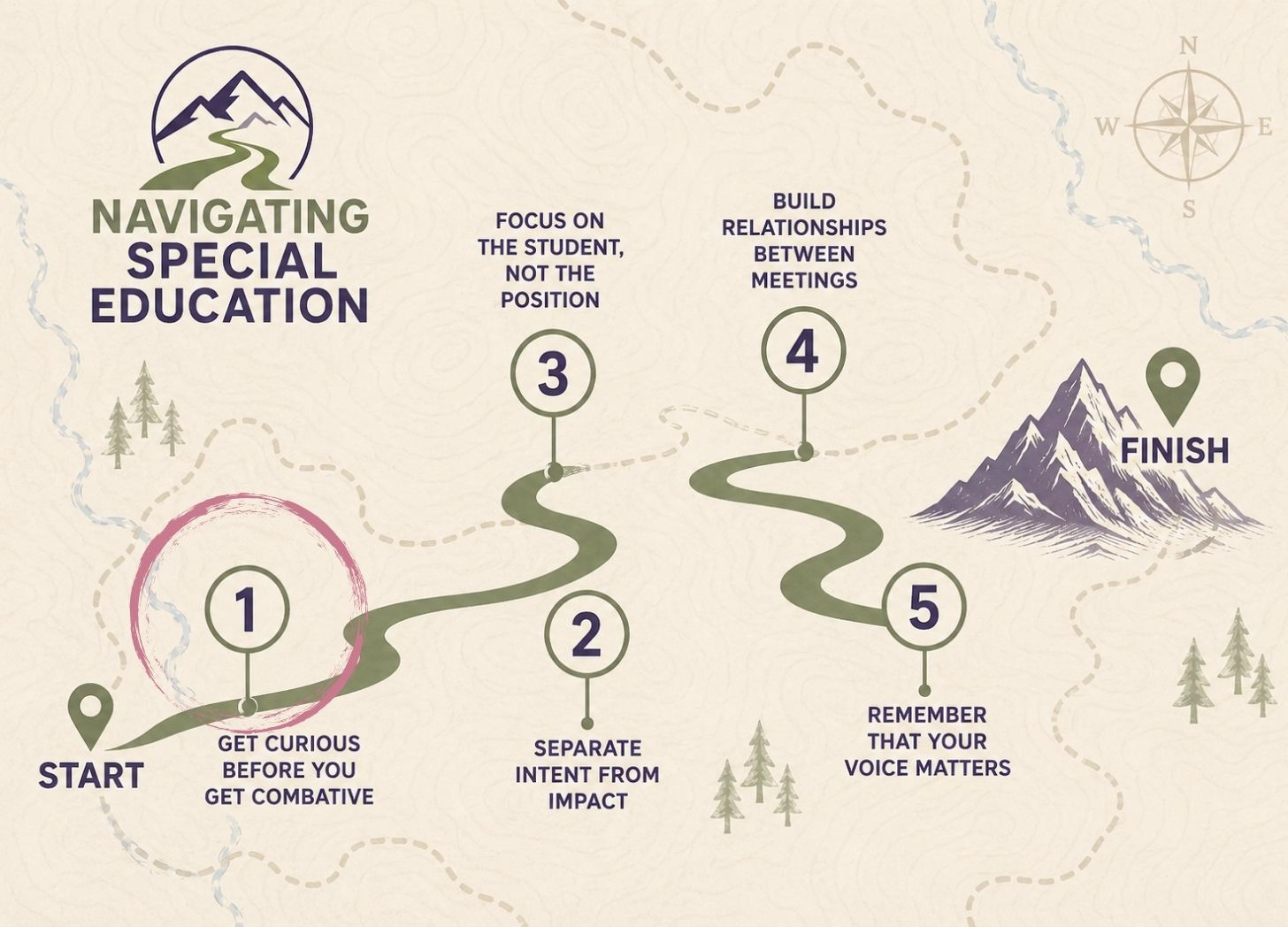
Where we are on the map. You just finished Step 1. Here’s the whole thing, and where we’re headed next.
Step 1: Get Curious Before You Get Combative (you are here)
When something doesn’t make sense, lead with a question instead of an accusation.
Step 2: Separate Intent from Impact (next)
How to name a real problem in writing, calmly and clearly, in a way the team can actually act on — with the tool to do it.
Step 3: Focus on the Student, Not the Position
When you disagree, bring the conversation back to your child’s needs rather than who’s right.
Step 4: Build Relationships Between Meetings
Trust is built in the small moments between meetings, not during the annual one.
Step 5: Remember That Your Voice Matters
You are the expert on your child, and you belong at that table.
If you find this resource helpful, please like and/or leave a comment.
It seems like this should be the approach that we take, but human nature gets in our way.That’s too bad.