

Step 2, up close — Separate Intent from Impact
I’m Maria Messer, Special Education Director, writer, and former special education teacher who has sat on nearly every side of the IEP table, including as the mom of a son with significant disabilities. More about me and this space →
This is Step 2 of a framework I'm building out one step at a time — each essay carrying its own tool you can bring to the table, each one building on the last. It picks up from Step 1, Get Curious Before you Get Combative, and starts with the introduction, Families Deserve a Map. If you're new here, start there.
Last time, curiosity got you in the door. You asked instead of accused, the room stayed open, and the team told you how the decision actually got made.
Now you know. And sometimes what you learn is that the decision is wrong.
This is the harder moment. Not the one where you disagree with a stranger who obviously doesn’t care about your kid. That one, in its own painful way, is simple. The hard one is when you disagree with people who clearly do care. The teacher who lights up talking about your son. The case manager who stayed late to answer your email. You can see the good intentions all over them.
And you still think they’re getting it wrong.
So you go quiet. Because it feels like you have to choose. Either these are good people doing their best, or there’s a real problem here and you have to make a scene about it. Name the problem, and you’re calling kind people incompetent. Stay kind, and you swallow the thing your child actually needs.
I want to take that choice off the table, because it was never a real one.
You can believe everyone at that table wants what’s best for your child and still name a problem.
Both things are true.
The good intentions are real. The impact on your child is also real. Holding one does not require you to let go of the other, and the whole skill of Step 2 is learning to keep both of them in your hands at the same time. That is the “both” this whole publication is named for.
The rest of this essay comes with the tool I built for it — the one that turns a worry into a written concern your team can actually act on. It’s waiting a little further down.
Families deserve a map.
The mistake almost everyone makes
Here is the quiet error that turns a solvable disagreement into a standoff.
We read intent backward from impact. My child is falling behind, therefore someone failed him. The plan is hurting her, therefore someone doesn’t care. It feels like logic. It runs so fast we barely notice it happening. But it skips a step, and the step it skips is the true one: impact tells you what landed. It tells you nothing about what was meant.
This is the heart of Difficult Conversations, the book that came out of the Harvard Negotiation Project. Douglas Stone, Sheila Heen, and Bruce Patton spent years on why hard talks go sideways, and one pattern showed up again and again. We judge ourselves by our intentions and everyone else by their impact on us. I know I meant well, so I forgive myself the fallout. I only feel your fallout, so I assume you meant it. Two people can walk out of the same meeting each certain they were the reasonable one.
You cannot see intent. It lives inside another person’s head, and you fill it in with a guess. When you’re frightened for your child, the guess skews dark. So the first move of Step 2 is almost embarrassingly simple: stop guessing. Assume the good intent is real, name the impact that’s real, and refuse to collapse them into a single verdict on whether these people are friends or enemies.
And this cuts both ways, which is the part I want you to pay attention to. The same reflex is running on the other side of the table. When you walk in braced and sharp, the team reads your impact and guesses at your intent, and their guess skews dark too. They decide you came to fight. You decide they came to stonewall. Nobody in the room actually meant what everyone else thinks they meant. Separating intent from impact is the one move that works no matter which chair you’re sitting in.
If this is landing, there’s a whole map like it — five steps, each with a tool you can bring to the table. It’s free, and new pieces arrive as I build them out.
Be soft on the people, hard on the problem
At the end of the last essay I promised we’d get here, to a phrase negotiators lean on: separate the people from the problem.
It comes from Getting to Yes, by Roger Fisher and William Ury, and it’s less gentle than it sounds. It doesn’t mean being nice. It means aiming your full force at the actual issue instead of at the person nearest to it. You can be warm toward the teacher and relentless about the reading data in the same breath. In fact that combination is the strong one. When you attack the person, they defend the person, and the problem sits untouched while you both bleed. When you attack the problem together, you’re on the same side of it, looking at the same thing.
Getting curious, back in Step 1, was how you kept the person on your side. Separating intent from impact is how you keep the problem in view without turning the person into it.
Why you write it down
Here’s where Step 2 asks something specific of you. You don’t just think this. You put it in writing.
Not because writing is more formal or more official. Because writing is where you get to be careful. In the room, under pressure, “the impact this is having on him” comes out as “you’re not helping my son,” and the moment curdles. On paper, the night before, you have time to do the harder and better thing: describe what you see without the verdict baked in.
Jack Gibb noticed this back in 1961, and we met him last time. Language that describes keeps people open. Language that judges puts them on guard. “The plan isn’t working” is a judgment. “Here’s what I’m seeing at home, and here’s what the data shows” is a description. Marshall Rosenberg built a whole practice on the same line — he called it the difference between observation and evaluation, between reporting what happened and rendering a verdict on it. Watch your own drafts and you’ll catch yourself sliding from one to the other without meaning to. He’s frustrated is an observation. He’s being neglected is a verdict. One invites the team to look with you. The other tells them the trial is already over.
Writing lets you catch that slide before the team ever reads it. That’s the whole reason the tool exists.
The Impact Notes — your download. A one-page template for turning a worry into a written concern the team can act on, plus a filled-in example so you’re not staring at a blank page.
It walks you through five short fields, in order, and the order is the point.
What I’m seeing. The plain, specific, dated observation. Not “he’s struggling,” but “three mornings this week he’s said his stomach hurts before school.” Concrete enough that no one can argue with the sighting itself.
What I believe you intend. You write the good intent down, on purpose, in your own hand. Naming it steadies you, and it tells the team you’re not building a case against them.
The impact on my child. The thing you’re actually worried about, stated as what’s happening to him rather than what someone did wrong.
What I’m asking for. One concrete, doable request. A concern with no ask is a complaint. A concern with a clear ask is a starting point.
How we’ll know it’s working. The measure you’ll both watch, so the next conversation has somewhere to stand.
Fill it in the night before. Bring it, or send it ahead. Either way, the careful version of you is the one that reaches the team, instead of the frightened version who says the thing she’ll replay in the parking lot.
The part I won’t pretend about
Separating intent from impact is not a solvent that dissolves every problem. It won’t.
Sometimes you assume good intent, name the impact cleanly, make the doable ask, and the answer is still no. Sometimes the good intent you generously assumed turns out not to be there. Naming impact clearly doesn’t guarantee the team acts on it. What it guarantees is that the problem is now on the table in a form they can’t misread as an attack, which means if they still don’t move, you’ve learned something real about where you actually stand. That clarity is worth having. You can’t decide whether to escalate until you know you gave the honest version of the concern a fair chance to land.
And assuming good intent is not the same as trusting forever. It’s the posture you start from, because starting anywhere else forecloses a partnership you might genuinely need. You can extend it and still watch what happens next.
Where this leaves you
You walked in thinking you had to choose between believing in these people and protecting your child. You don’t. You can hold the good intent and name the hard impact, and you can do it in writing, calmly enough that the team hears the concern instead of the accusation.
Believe everyone wants what’s best. Name the problem anyway. Both things are true, and your child needs you to be the one person in the room who can carry both at once.
That’s Step 2 — the second leg of the map. Next we take the concern you’ve now learned to name and aim it: back at the student, and away from who’s right.
If you ever want to read further (none of it required), these are the books behind this essay: Difficult Conversations, by Douglas Stone, Sheila Heen, and Bruce Patton; Getting to Yes, by Roger Fisher and William Ury; Nonviolent Communication, by Marshall Rosenberg; Amy Edmondson’s work on psychological safety (The Fearless Organization); and Jack Gibb’s 1961 work on defensive communication.
— Maria

Before you go — I’d love to hear from you.
This series lives in the special education world because that’s the table I know best, from both sides of it. But the move underneath Step 2 isn’t really about IEPs. It’s about any room where you’re advocating for someone you love, and the people across the table have good intentions and are getting something wrong — a parent’s care team, a hospital discharge, an aging parent’s providers, a 504 meeting, a doctor who isn’t hearing you.
So I’ll ask it broadly: when have you had to name a problem to people who genuinely cared? What made it land — or what made it curdle?
Tell me in the comments. I read every one, and your stories shape what I build next.
If you find this resource helpful, please like and/or leave a comment.
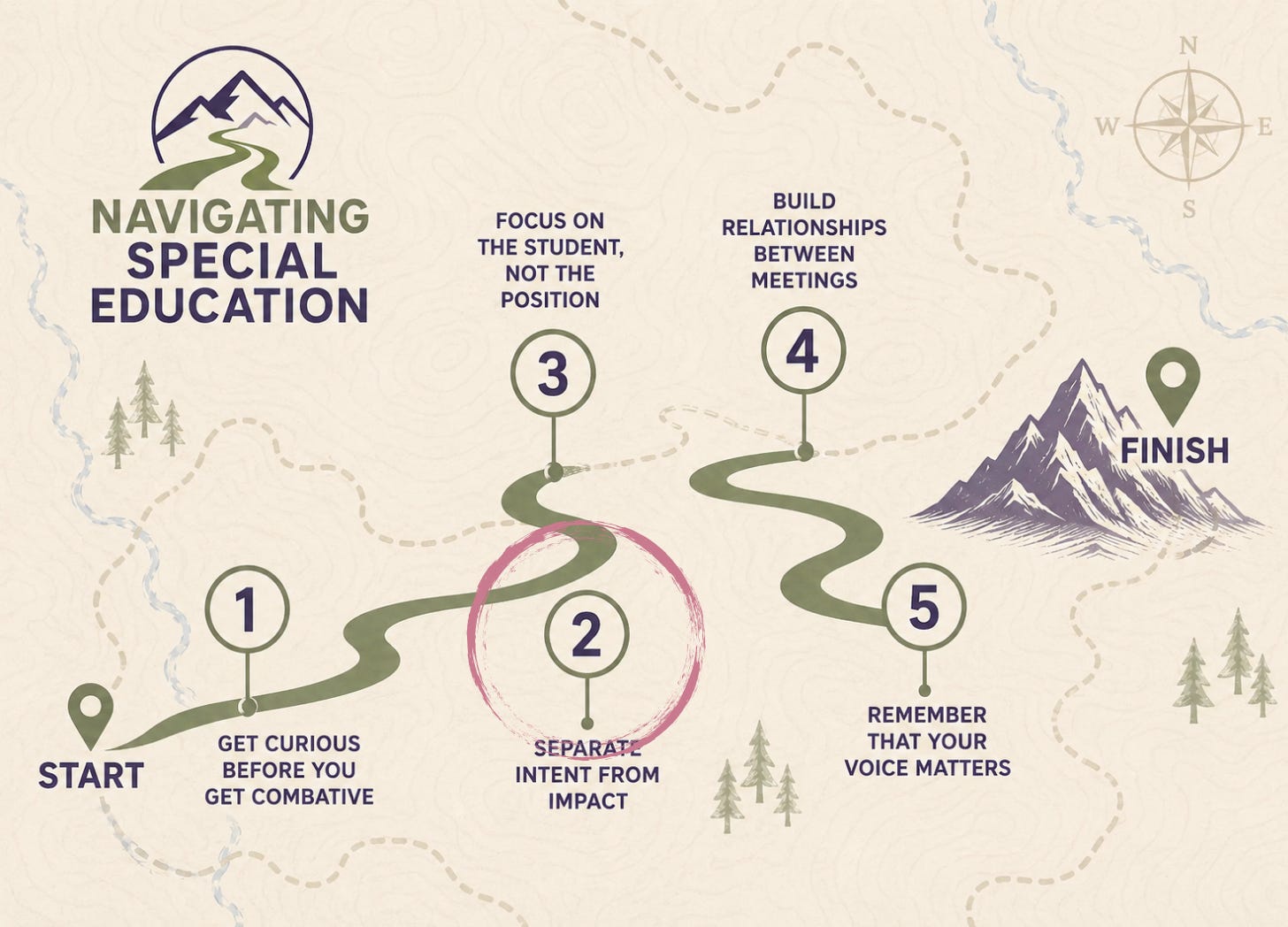
Where we are on the map. You just finished Step 2. Here’s the whole thing, and where we’re headed next.
Step 1: Get Curious Before You Get Combative
When something doesn’t make sense, lead with a question instead of an accusation.
Step 2: Separate Intent from Impact (you are here)
You can believe everyone wants what’s best for your child and still name a problem.
Step 3: Focus on the Student, Not the Position (next)
When you disagree, bring the conversation back to your child’s needs rather than who’s right.
Step 4: Build Relationships Between Meetings
Trust is built in the small moments between meetings, not during the annual one.
Step 5: Remember That Your Voice Matters
You are the expert on your child, and you belong at that table.
This is such a great resource!